
What is Digital Coherence?
Here’s what I see when I look at most businesses online.
The website says one thing. The Instagram bio says something slightly different. The email welcome sequence was written for a version of the business that doesn’t exist anymore. The bio link goes to the homepage — not the thing they’re actually selling. And the “about” page? Written three years ago by someone who doesn’t work there anymore.
None of it is terrible on its own. But together? It’s a stranger at every touchpoint. A potential client crosses from your social profile to your website and isn’t quite sure they’re in the right place. That uncertainty costs you — in trust, in conversions, in the kind of people who find you.
I call that the opposite of digital coherence.

So What IS Digital Coherence?
Digital coherence is what happens when every piece of your digital presence is telling the same story.
Not identical copy on every platform — that’s not the point. The point is that your website, your social profiles, your content, your SEO, and your systems are all pointing in the same direction. When someone finds you on LinkedIn and then clicks through to your website, they don’t feel a disconnect. When an AI tool tries to summarize what your business does, it gets it right — because you made it clear enough to get right.
It’s not a program. It’s not a course. It’s a way of looking at your online presence as a whole instead of a collection of separate pieces.
Here’s the thing: most businesses aren’t incoherent on purpose. It happens gradually. You update the website but forget the email sequence. You change your offer but the old services page is still live. You hire a designer who writes your copy in a voice that sounds nothing like you. Each piece made sense at the time. But nobody stepped back and looked at all of it together.
That’s what I do. I step back and look at all of it together.
When I audit a digital presence for coherence,
I’m looking at eight things:
Offer Clarity
Can a stranger understand what you do and who it’s for within five seconds of landing on any page? Not just the homepage — any page. I’m looking at whether the offer is specific, whether it’s front and center, and whether it reads the same way everywhere — or whether it gets quietly buried, hedged, or explained differently depending on where you find it. If someone has to work to understand what you do, they don’t. They leave.
Voice & Tone
Does everything sound like it came from the same person? Or does the website sound corporate, the Instagram sounds casual, and the email sounds like a third person entirely? Voice is one of the fastest trust signals there is — people feel a mismatch before they can name it. When different parts of your presence sound like they were written by different people, the whole thing feels off. Not wrong, exactly. Just not quite trustworthy.
Message Coherence
Is the same core story being told everywhere? Not the same words, but the same positioning. The same “why us.” This breaks more often than people expect — not because anything is wrong exactly, but because things get updated piecemeal. The website reflects where you were two years ago. The LinkedIn bio reflects where you are now. The email sequence is somewhere in between. A potential client moving through all of it picks up the inconsistency even if they can’t name it.
CTA Clarity
Does every page give someone a clear next step? Not just “learn more” — a specific, logical next step that matches what the page is about. I’m looking at whether the ask makes sense given what just came before it, whether there’s one clear action or three competing ones, and whether the CTA is appropriate for where someone is in the decision. A page that ends with nothing loses the person it just convinced.
Cross-Platform Alignment
If someone found you on Instagram and then visited your website, would they recognize it as the same business? This is where the seams show — where the Instagram is warm and personal, the website is formal and distant, and the LinkedIn bio describes a different version of the offer entirely. Most people find you in one place before they go looking in another. That moment of “wait, is this the same person?” is a trust gap. Some people cross it. Most don’t bother.
Visual Consistency
Does it look like the same brand everywhere? Not pixel-perfect, but recognizable. I’m looking at whether someone could land on your Instagram, your LinkedIn, and your website and immediately know they’re in the same place — the same color palette, the same image style, the same general visual language. It doesn’t have to be a polished design system. It has to be consistent enough that it reads as intentional rather than assembled from leftover parts.
Link Health
Do the connections between your platforms actually work? Bio links, CTAs, redirects — all of it. Broken links are invisible to the owner and devastating to the visitor. I check every path a potential client might take from discovery to contact — because the moment someone hits a dead end, they don’t look for another way in.
AI Visibility
When someone asks ChatGPT, Claude, or Gemini to recommend someone in your niche, does your name come up? AI doesn’t rank pages — it recommends brands it can form a clear picture of. If your messaging is fragmented or inconsistent across platforms, AI either skips you entirely or gets you wrong. There’s no page 2 to recover on.
Why It Matters Now
Five years ago, coherence was a nice-to-have. Your website could be slightly messy and you’d still get found because the competition was messy too.
That’s not the world anymore.
Google’s AI Overviews are pulling answers directly from web pages. ChatGPT and Perplexity are summarizing businesses based on whatever they can find. If your messaging is scattered, the AI gets confused — and it either misrepresents you or skips you entirely.
You can’t control the algorithms. But you can control how clear you are. How consistent. How easy to understand.
That’s what coherence gives you. Not a guarantee of rankings — a guarantee that when someone or something tries to figure out what you do, the answer is right.
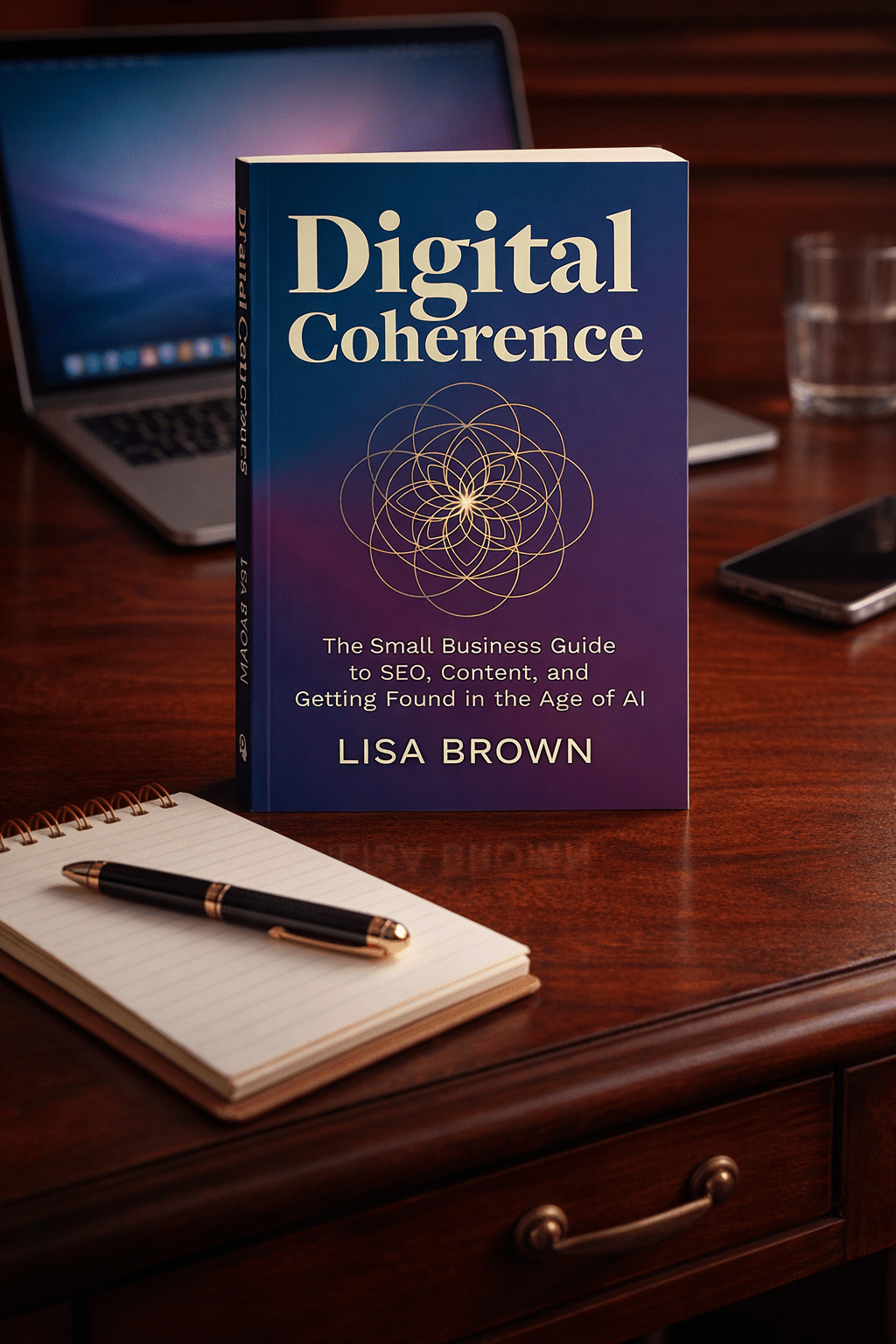
I wrote a book about all of this.
It’s called Digital Coherence — it walks through the full framework, how to audit your own presence, and how to build something that works in the age of AI search. Written for business owners, not developers.
Want to know where your coherence is breaking?
There are two ways to find out.
The Clarity Session — $1497
Everything in the audit, plus a 60–75 minute Zoom where we go through what I found together.
I come to that call having already spent two to three hours in your business — so we use the hour for what matters.
Not sure which one is right? Start with the audit. You can add the conversation after.
Prefer to start on your own?
The Digital Coherence Companion Workbook — $37 — is the self-guided version of the same framework.
Not sure what “aligned” even looks like for you yet?
Start with The Me-Shaped Discovery Journal — $47 — and build the foundation first.